
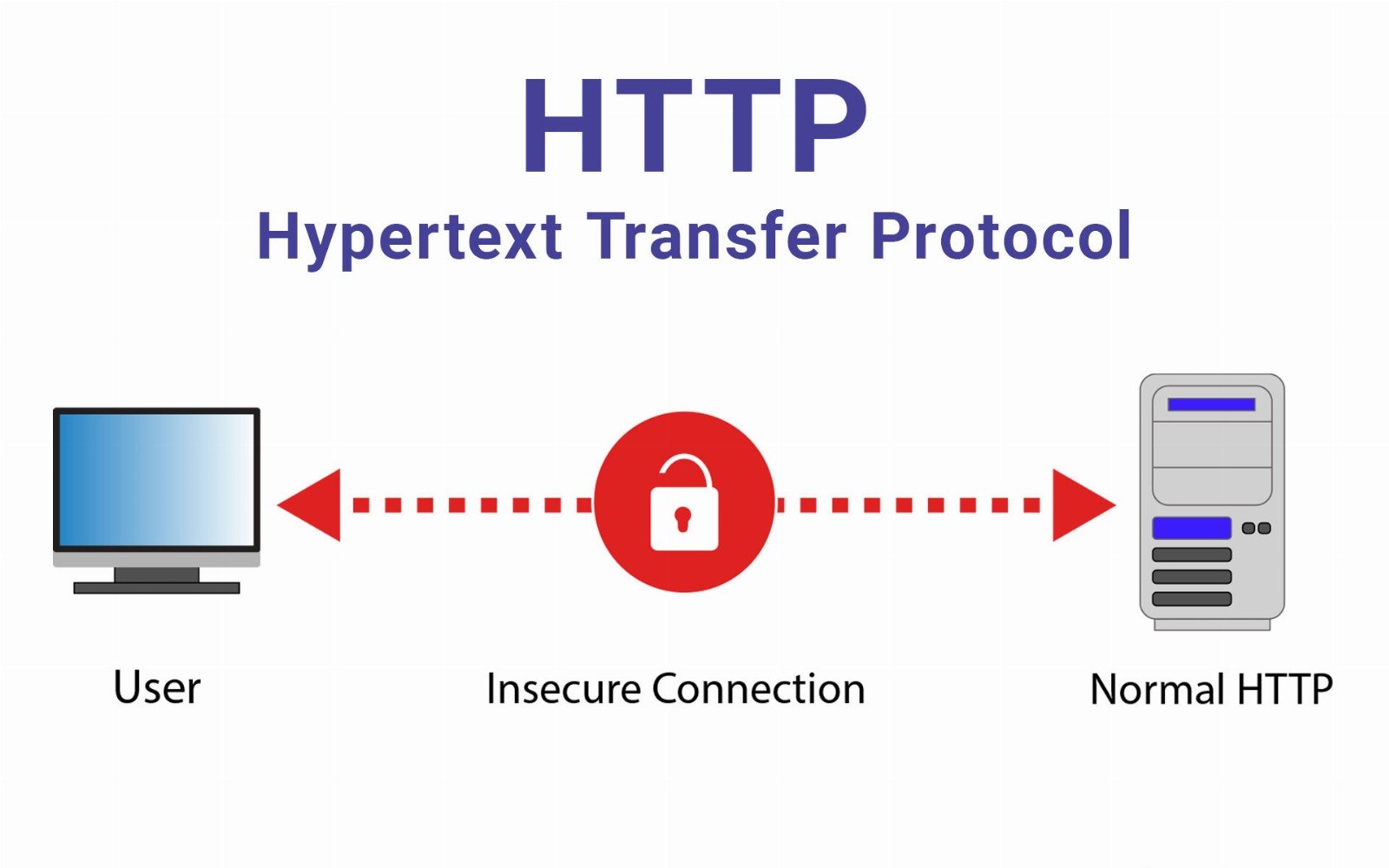
HTTP, or Hypertext Transfer Protocol, is the foundation of data communication on the World Wide Web. It is a client-server protocol that defines how messages are formatted and transmitted between web browsers (clients) and web servers. When you enter a web address (URL) in your browser, your browser sends an HTTP request to the server, which responds with the requested content — such as an HTML page, image, or video.
HTTP uses a request-response model and operates primarily over TCP/IP (Transmission Control Protocol/Internet Protocol) on port 80 (for unencrypted traffic). When encrypted via TLS, it becomes HTTPS, which operates on port 443.
How HTTP Works
- Client sends a request
Example:GET /index.html HTTP/1.1 - Server processes the request
It checks for the requested resource and prepares a response. - Server sends a response
Example:HTTP/1.1 200 OKfollowed by the content. - Connection may be closed or reused
HTTP/1.0 closes the connection by default; HTTP/1.1 and later support persistent connections.
Key Features
- Stateless Protocol:
Each HTTP request is independent; the server doesn’t retain any memory of previous requests unless cookies or sessions are used. - Text-Based:
HTTP messages are readable and easy to debug. - Methods (Verbs):
GET: Retrieve dataPOST: Submit data to be processedPUT: Update existing dataDELETE: Remove dataHEAD,OPTIONS,PATCH: Additional operations for specific use cases
- Status Codes:
200 OK: Success301/302: Redirect404: Not found500: Server error
Pros of HTTP
- Simplicity and Universality
HTTP is easy to implement, widely understood, and supported by virtually all devices and applications. - Human-Readable
Its plain-text format makes it easy to understand, debug, and test with tools like Postman or cURL. - Hyperlinking and Resource Sharing
Built to support hypertext, it powers linking between documents, images, APIs, and multimedia. - Extensibility
Easily extended with headers, status codes, and custom methods. Modern applications like REST APIs are built on HTTP.
Cons of HTTP
- Not Secure (without HTTPS)
HTTP transmits data in plain text, making it vulnerable to interception, spoofing, and man-in-the-middle attacks. - Statelessness
Since it doesn’t remember previous requests, extra mechanisms (cookies, sessions, tokens) are needed for tracking/logins. - High Overhead for Simple Tasks
Every request includes headers and metadata, which may be excessive for lightweight communication.
HTTP vs HTTPS
| Feature | HTTP | HTTPS |
|---|---|---|
| Security | None (plaintext) | Encrypted via TLS |
| Port | 80 | 443 |
| Use Case | Insecure/internal applications | All public-facing web applications |
| SEO Impact | No ranking benefit | Google favors HTTPS in ranking |
Conclusion
HTTP is the backbone of web communication, enabling browsers and servers to exchange data in a standardized, flexible way. While it offers simplicity and universal compatibility, it is not secure by default. Modern web applications and sites should always use HTTPS, the secure version of HTTP, to protect users and data. HTTP’s versatility and extensibility continue to make it central to web development, REST APIs, and cloud communication.