
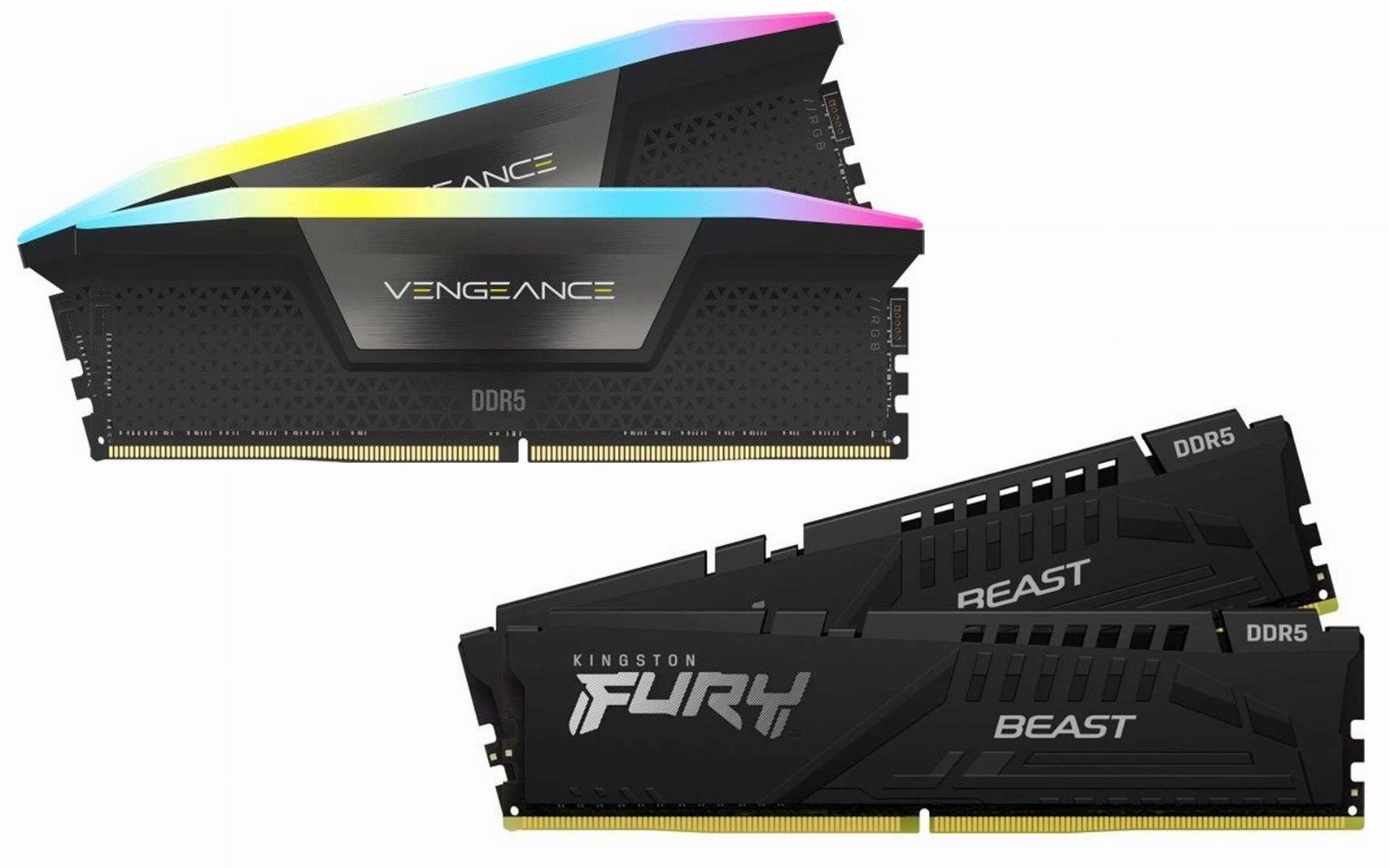
DDR5 (Double Data Rate 5) RAM is the latest generation of synchronous dynamic random-access memory, introduced as a successor to DDR4. DDR5 offers significant improvements in speed, capacity, and power efficiency. Launched commercially in 2020, DDR5 aims to meet the increasing demands for higher performance and greater bandwidth in applications ranging from advanced computing environments to consumer electronics.
DDR5 RAM introduces enhanced features such as doubled data rates and densities compared to DDR4, with speeds potentially starting at 4800 MHz and expected to reach beyond 8400 MHz in future implementations. The voltage has been standardized at 1.1V, and it introduces a new architecture that allows for increased scalability and efficiency in data handling. Each DDR5 module is designed to be more reliable and power-efficient, with on-die error-correcting code (ECC) and decision feedback equalization (DFE) to enhance signal integrity and extend the limits of clock speeds and data transfer.
Pros:
- Higher Speeds and Bandwidth: DDR5 provides significantly higher data rates and bandwidth compared to DDR4, which enhances overall system responsiveness and enables more effective multitasking.
- Improved Power Efficiency: Despite the higher performance, DDR5 uses more refined power management techniques and operates at a slightly reduced voltage, contributing to better overall energy efficiency.
- Increased Capacity: DDR5 modules support larger capacities per DIMM, which is beneficial for data-intensive applications like server environments, data analytics, and AI computing.
Cons:
- Cost: As with any new technology, DDR5 RAM is initially more expensive than its predecessors, potentially limiting its adoption rate until prices stabilize.
- Compatibility: DDR5 is not backward compatible with DDR4 slots, meaning that upgrading to DDR5 requires a compatible motherboard and potentially other system components.
- Availability: Early in its release cycle, DDR5 might face limited availability, and it may take some time for the market to fully embrace and support the new standard across a wide range of products.
DDR5 RAM sets a new standard for future computing needs, addressing the bandwidth and performance challenges faced by modern applications and technologies. It is especially suited for environments that require high-performance computing capabilities, such as advanced gaming, professional workstations, and servers that handle large amounts of data. As the technology matures and becomes more widely adopted, DDR5 is expected to play a crucial role in the next generation of computing developments.