
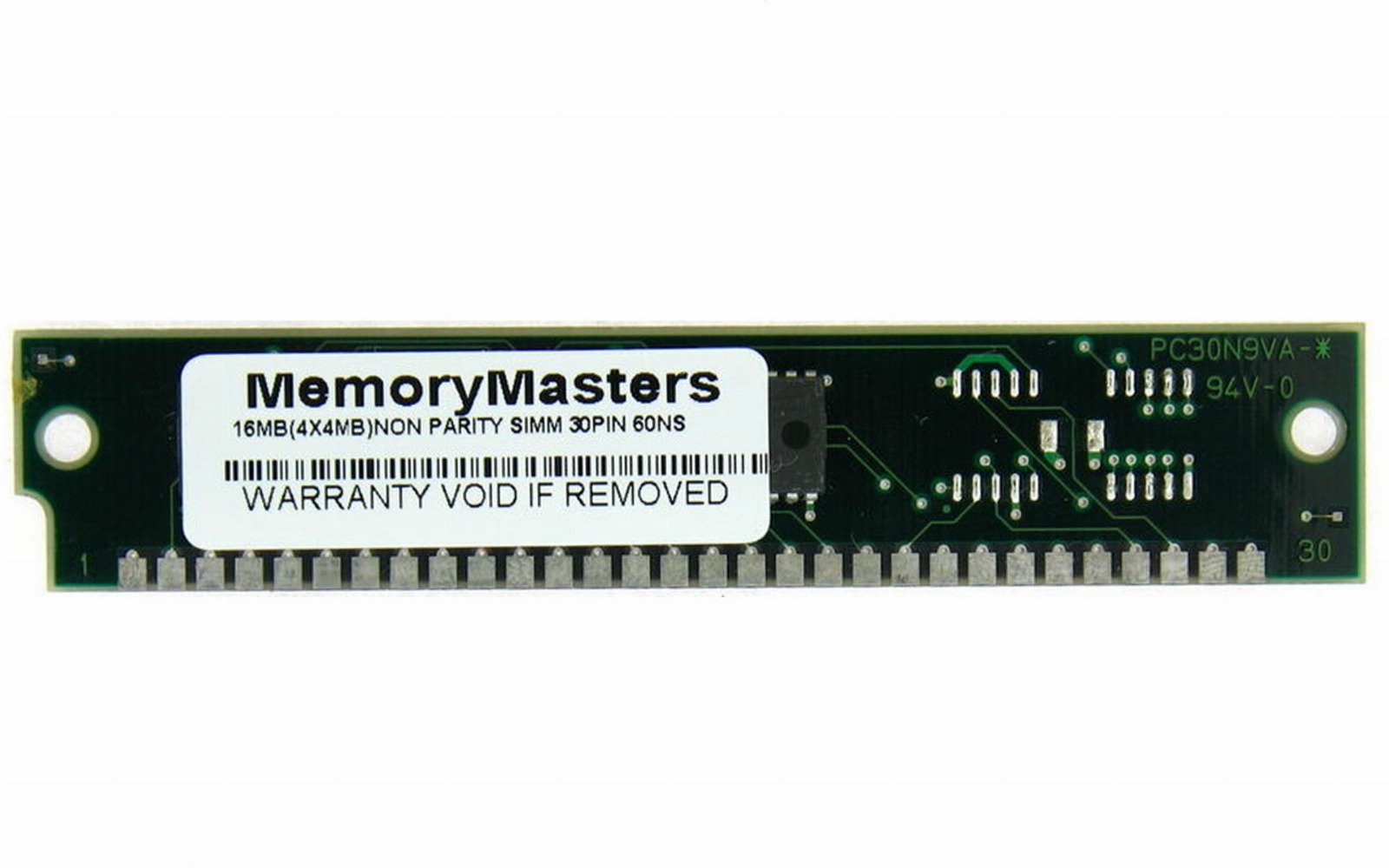
SIMM, which stands for Single In-line Memory Module, is an older type of random-access memory module that was commonly used in personal computers from the late 1980s until the late 1990s. SIMMs consist of a series of dynamic random-access memory (DRAM) chips mounted on a small circuit board. They were an advancement over individual memory chips, offering easier installation and maintenance. SIMMs come in two primary types based on the number of pins they contain: 30-pin and 72-pin configurations.
30-pin SIMMs provide a 8-bit data path and were commonly used in older 286 and 386 computers. 72-pin SIMMs, introduced with the advent of 486 and early Pentium systems, provide a 32-bit data path, which aligns better with the 32-bit architecture of these CPUs. Each SIMM is inserted into a memory socket on the motherboard, and 72-pin SIMMs typically need to be installed in pairs to match the CPU’s 32-bit data bus.
Pros:
- Simplified Installation: Compared to earlier individual memory chips, SIMMs made upgrading memory easier and faster.
- Cost-Effective: For their time, SIMMs provided a cost-effective way to increase system memory, supporting more complex applications and operating systems.
- Compact Design: The integration of multiple memory chips onto a single module helped conserve space inside computer cases.
Cons:
- Limited Capacity: SIMMs typically offered lower capacity and speed compared to later memory module designs like DIMMs.
- Partial Compatibility: 72-pin SIMMs often needed to be installed in pairs to function correctly, which could complicate upgrades and limit configuration options.
- Outdated Technology: SIMMs have been largely phased out in favor of more advanced technology such as DIMMs, which offer higher speeds, greater capacity, and easier installation.
SIMMs were instrumental in the evolution of computer memory, simplifying the upgrade process and making it more accessible to the average user. However, due to technological advancements and the demands of newer software and operating systems, SIMMs have become obsolete, replaced by more modern memory modules that provide greater capacity, speed, and flexibility.