
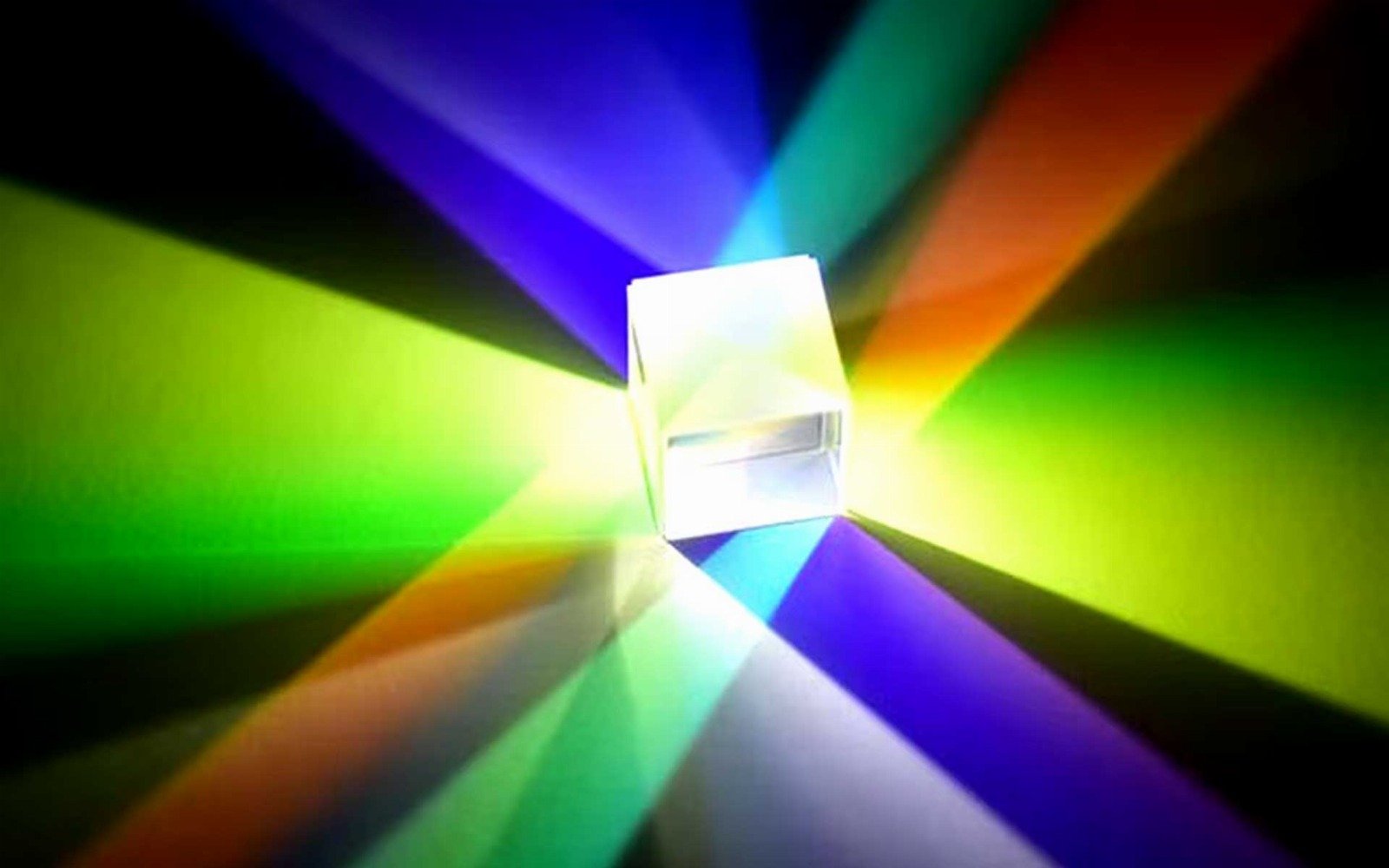
A prism is a transparent optical element with flat, polished surfaces that refract light. Typically made from glass or other transparent materials, prisms can disperse light into its component colors (a phenomenon known as dispersion) and be used to reflect it. The most recognizable type of prism is the triangular prism, which is widely used to break light up into its spectral colors.
Applications in Optics: Prisms are fundamental components in various optical devices, including cameras, binoculars, periscopes, and scientific instruments. They manipulate light to achieve effects like color separation, light reflection, and image inversion. In projectors, prisms are used to split light into primary colors and then recombine these colors after they have passed through separate image-forming units. This process is essential for devices like 3LCD projectors, where three different colors are processed simultaneously.
Pros:
- Versatility: Prisms can be used for a wide range of applications in optical devices, from simple light refraction and reflection to complex image and light beam manipulation.
- Precision: Prisms can precisely direct and control light paths, which is crucial for applications requiring high levels of optical accuracy.
- Durability: Made from robust materials like glass, prisms are durable and can withstand significant environmental and mechanical stress.
Cons:
- Cost: High-quality prisms, especially those made from specialized materials or requiring precise angles, can be expensive.
- Sensitivity to Alignment: Prisms must be aligned very accurately within optical systems to function correctly. Misalignment can lead to optical aberrations or inefficiency.
- Size and Weight: In some applications, particularly in portable devices, the size and weight of glass prisms can be a disadvantage compared to other light-manipulating options like mirrors or diffractive elements.
Conclusion: Prisms are crucial in many areas of optics due to their ability to manipulate light efficiently and precisely. They play a critical role in enhancing the functionality of various imaging and optical devices, contributing to advancements in photography, cinematography, and scientific research. While prisms offer excellent durability and optical precision, their cost, and physical characteristics need to be carefully considered in the design of compact and cost-effective optical systems.