
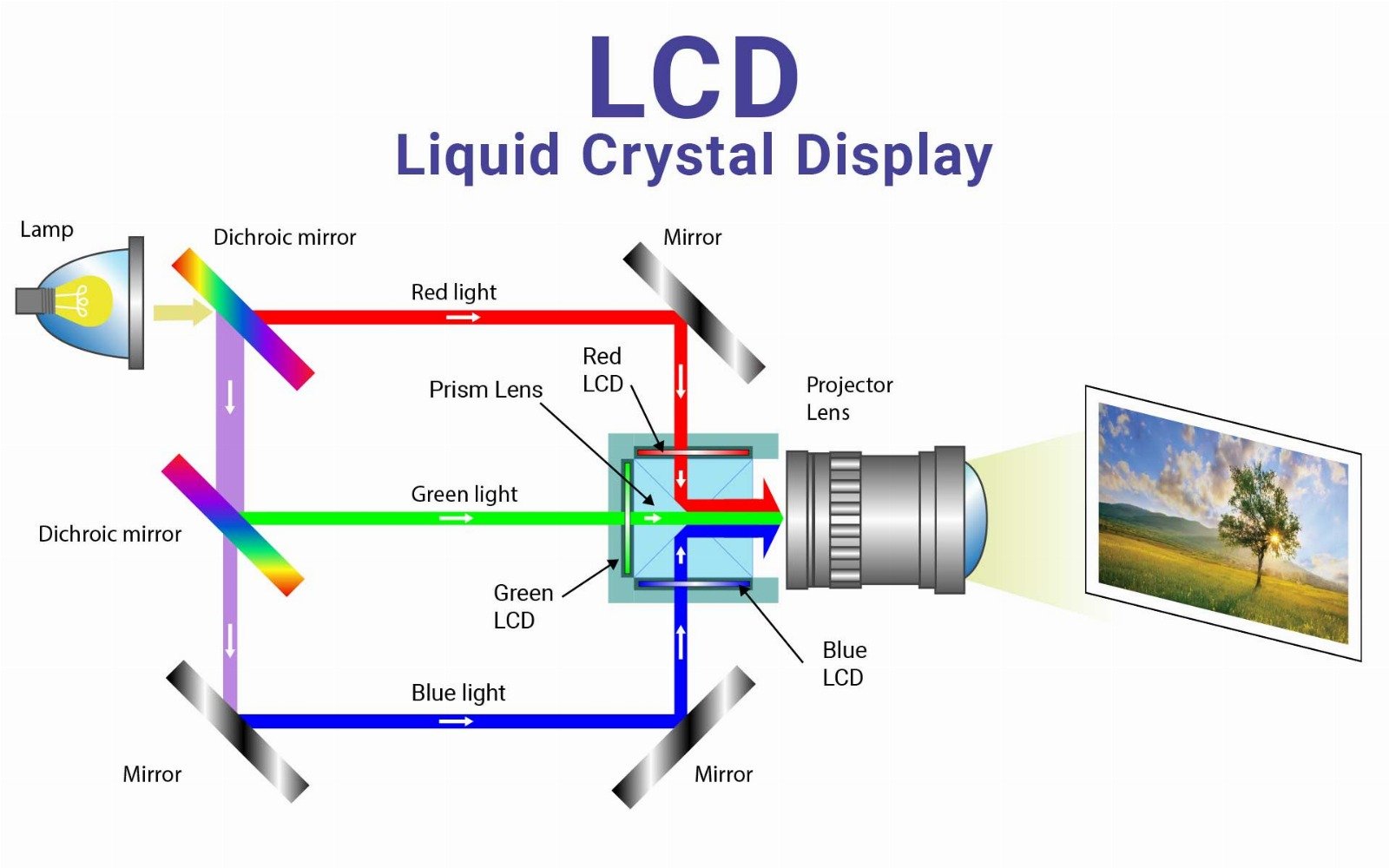
LCD (Liquid Crystal Display) projectors use liquid crystal panels to project images onto a screen, making them one of the most common types of projectors in both educational and business settings. This technology involves the use of three liquid crystal panels (one each for red, green, and blue components of the image), a powerful light source, and a prism that combines the light, which is then projected onto the screen.
How It Works: An LCD projector's light source sends light to three dichroic mirrors specially shaped to only reflect a certain wavelength of light (specifically red, green, or blue). Each beam of colored light then passes through its own LCD panel, which regulates the intensity of each color passing through it by blocking out particular pixels using liquid crystals. These light beams are then recombined and passed through a prism to create the final full-color image that exits the projector lens and is cast onto the screen.
Pros:
- Color Accuracy: LCD projectors are known for producing bright, vivid colors, thanks to their separate LCD panels for each primary color.
- Sharpness and Clarity: Provides clear images with defined edges, making them ideal for presentations involving detailed graphics or fine text.
- Brightness: Generally, LCD projectors emit brighter images, which makes them effective even in rooms with ambient light.
Cons:
- Pixelation: In some models, especially those with lower resolutions, individual pixels may be visible in the projected image, known as the "screen door effect."
- Contrast: Typically, LCD projectors do not produce as deep blacks as DLP projectors, which can result in lower contrast ratios.
- Maintenance: LCD projectors require regular maintenance to clean filters and prevent overheating, as dust and heat can significantly impact performance.
Conclusion: LCD projector technology offers a reliable and efficient solution for environments where vivid colors and brightness are crucial, such as classrooms, meeting rooms, and conferences. While they excel in color reproduction and image clarity, the potential need for frequent maintenance and issues with pixel visibility and contrast are considerations for potential users. Nevertheless, for many educational and business applications, LCD projectors remain a popular choice due to their effectiveness in displaying detailed and colorful presentations.