
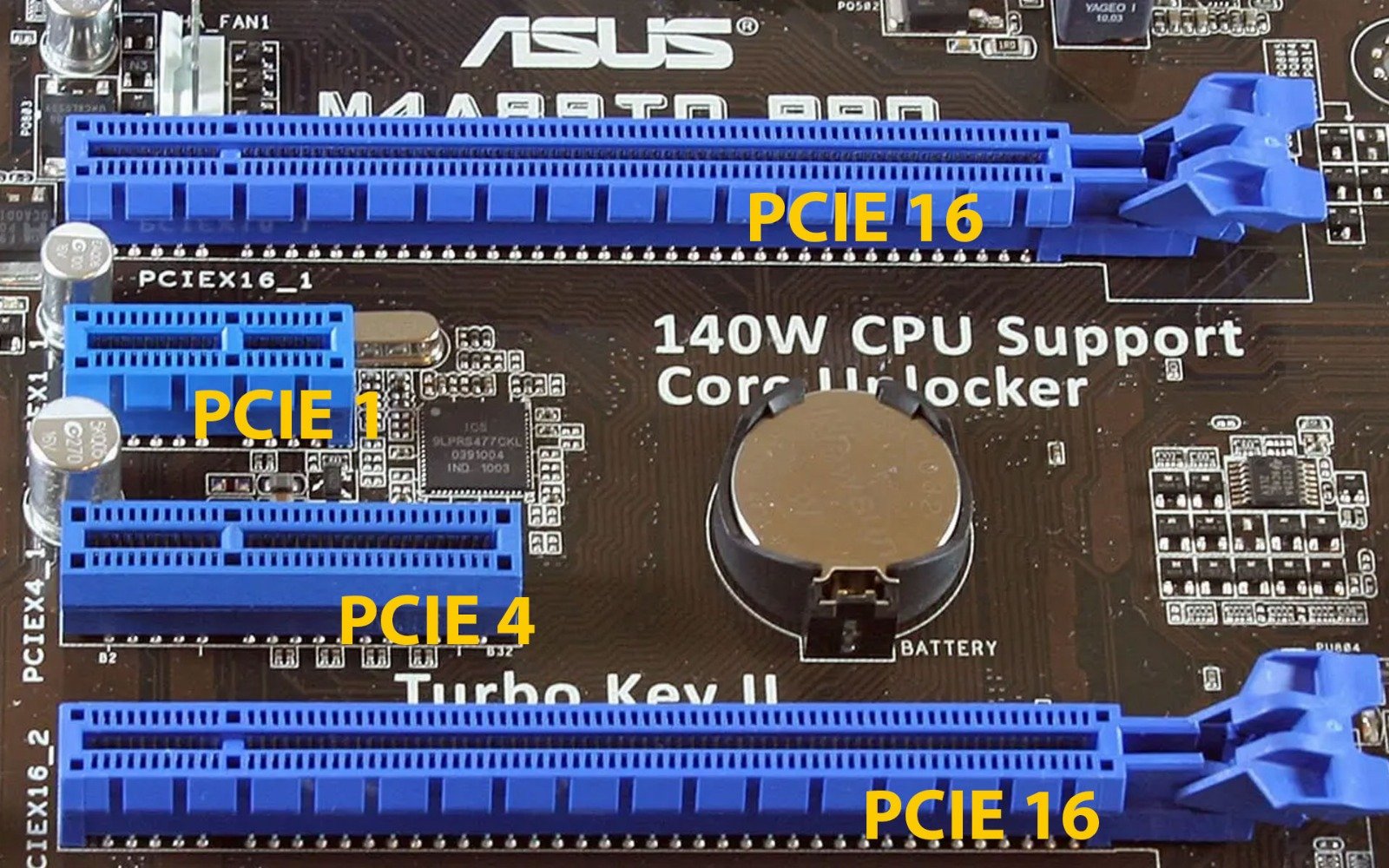
PCIe, short for Peripheral Component Interconnect Express, is a high-speed interface standard for connecting high-speed components to the motherboard of a computer. It has largely replaced the older PCI, PCI-X, and AGP bus standards and is universally used in modern computers for a wide range of purposes. PCIe is used to connect various hardware components such as graphics cards, SSDs, Wi-Fi cards, and network cards, among others.
PCIe operates on a point-to-point connection architecture with dedicated serial links called lanes. These lanes come in configurations of x1, x4, x8, x16, and x32, indicating the number of lanes and thus the bandwidth available to the connected device. Each lane consists of two pairs of wires, one for sending and one for receiving data, and PCIe slots can support different lane configurations depending on the motherboard and the device requirements.
Key Features of PCIe:
- Scalability: Allows multiple lanes for communication (x1, x4, x8, x16), increasing data throughput.
- Backward Compatibility: Newer devices can work in older slots, and older devices can work in newer slots, though performance is limited by the older specification.
- Point-to-Point Communication: Unlike PCI, which used shared parallel buses, PCIe uses serial, point-to-point communication, improving efficiency.
PCIe Versions and Their Speeds:
| PCIe Version | Transfer Rate (per lane, per direction) | Total Bandwidth (x16 configuration) | Release Year |
|---|---|---|---|
| PCIe 1.0 | 250 MB/s | 4 GB/s | 2003 |
| PCIe 2.0 | 500 MB/s | 8 GB/s | 2007 |
| PCIe 3.0 | 1 GB/s (or 8 GT/s) | 16 GB/s | 2010 |
| PCIe 4.0 | 2 GB/s (or 16 GT/s) | 32 GB/s | 2017 |
| PCIe 5.0 | 4 GB/s (or 32 GT/s) | 64 GB/s | 2019 |
| PCIe 6.0 | 8 GB/s (or 64 GT/s) | 128 GB/s | 2022 |
Pros:
- High Bandwidth: PCIe provides substantial bandwidth per lane, and its scalable lane configurations allow for versatility in building systems to meet specific performance needs.
- Low Latency: The point-to-point nature of PCIe connections ensures low latency, which is crucial for performance-critical applications such as gaming and high-performance computing.
- Scalability: PCIe supports hot swapping and is designed to be scalable, enabling future expansions and upgrades without major overhauls of the existing hardware.
Cons:
- Cost: Implementing PCIe, especially the higher bandwidth versions, can be expensive due to the complex nature of the hardware and the technology involved.
- Compatibility Issues: While PCIe is backward compatible within its generations, there can be physical and performance compatibility issues between different versions and configurations.
- Complexity in Configuration: Managing PCIe configurations, especially in systems with multiple high-performance components, can require careful planning to optimize the use of available lanes and bandwidth.
PCIe is foundational to modern computing, providing a robust and efficient way to expand and customize computer systems. Its continued development and adaptation have kept it at the forefront of technology, supporting the latest innovations in hardware component design and performance requirements.