
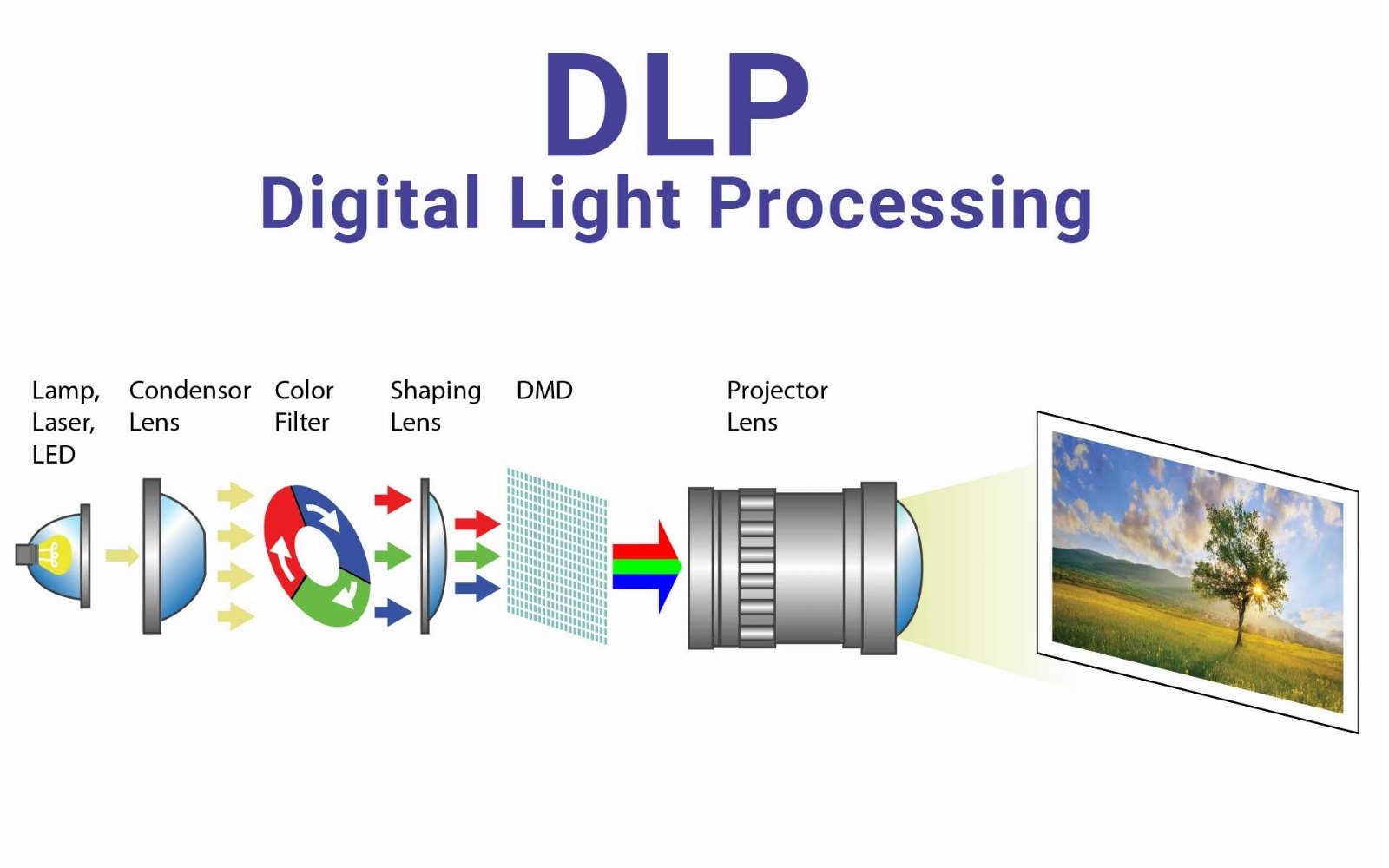
DLP, short for Digital Light Processing, is a display technology widely used in projectors and video displays. Developed by Texas Instruments, DLP works using a digital micromirror device (DMD), which consists of thousands to millions of tiny mirrors controlled at the micro level. Each mirror represents a pixel in the projected image, and by rapidly tilting toward or away from the light source, these mirrors create a light or dark pixel on the projection screen.
DLP projectors come in single-chip or three-chip configurations. Single-chip DLP projectors use a rapidly spinning color wheel to create sequential colors which, when combined with the on and off actions of the mirrors, produce the full-color image that viewers see. Three-chip models use a prism to split light into primary colors (red, green, and blue), and each color has its own DMD chip, providing more color accuracy and brighter output.
Pros:
- Sharp Image Quality: DLP projectors are known for their sharp images and excellent native contrast ratios, making them ideal for home cinema and business presentations.
- Reliability: The DLP chip is highly reliable, with a sealed design that prevents dust accumulation and thus reduces maintenance needs.
- Color Accuracy and Brightness: Three-chip DLP projectors provide exceptional color accuracy and brightness, with no color wheel and therefore no color breakup or "rainbow effect" that can be seen in single-chip DLP projectors.
Cons:
- Rainbow Effect: Single-chip DLP projectors can sometimes produce a rainbow effect, where bright colors separate into red, green, and blue. This can be distracting, especially in high-contrast scenes.
- Noise: The color wheel in single-chip DLP projectors can produce a whirring sound, which may be noticeable in quiet environments.
- Cost: Three-chip DLP projectors are typically more expensive than their single-chip counterparts due to their enhanced color and brightness capabilities.
Conclusion: DLP technology offers a reliable and high-quality projection solution that is suitable for a wide range of applications, from home theaters to professional settings. While single-chip DLP projectors are more affordable and suffice for general use, three-chip versions provide superior performance for environments where color accuracy and image quality are critical. Whether for educational purposes, business presentations, or cinematic experiences at home, DLP technology continues to be a popular choice due to its sharpness, reliability, and overall performance.