
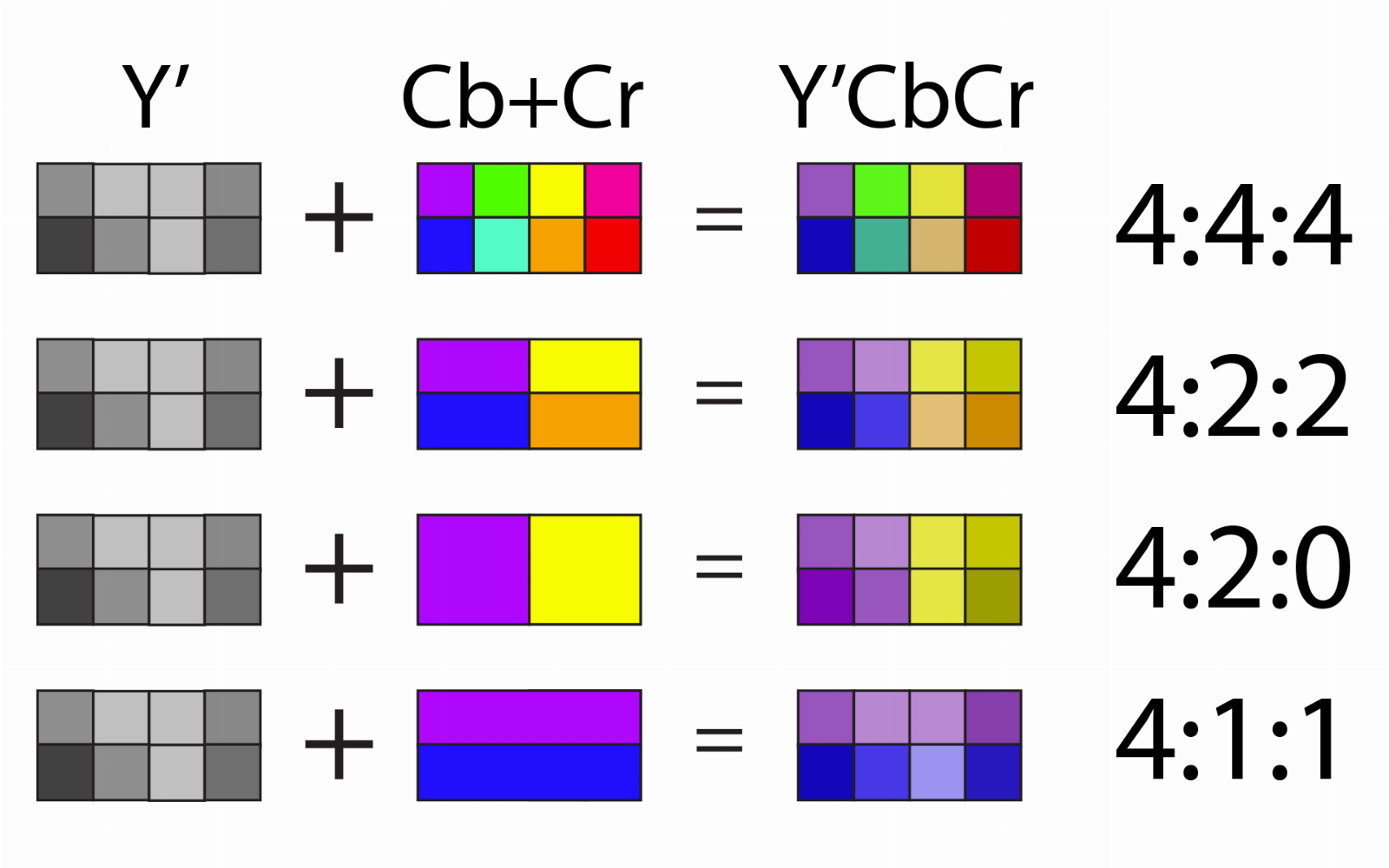
The technique involves reducing the resolution of chrominance data (color information) while keeping the luminance data (light intensity) at a higher resolution. This method exploits the human eye's lower sensitivity to color detail compared to luminance, allowing for more efficient data compression. Common subsampling ratios include 4:4:4, 4:2:2, and 4:2:0, where the first number represents the sampling rate of the luminance channel, and the following numbers represent the chrominance channels.
The most commonly used subsampling in video compression is 4:2:0, which offers a good balance between compression and quality, reducing the color resolution by half horizontally and vertically. This is widely used in broadcast media, streaming, and Blu-ray discs. In contrast, 4:4:4 subsampling does not reduce chrominance data at all, preserving full-color information, which is ideal for high-end video production and applications requiring precise color reproduction, such as graphic design and medical imaging.
Pros:
- Efficient Compression: Reduces file sizes and bandwidth usage significantly, facilitating easier storage and faster transmission of video data.
- Widely Supported: 4:2:0, the most common subsampling format, is supported by virtually all digital video and streaming standards, ensuring broad compatibility.
- Maintains Perceived Quality: By exploiting the human visual system's characteristics, subsampling can reduce data rates with minimal loss of perceived image quality.
Cons:
- Color Detail Loss: Reduces the resolution of the color information, which can lead to artifacts such as color bleeding and less sharp edges in high-contrast areas.
- Not Suitable for All Uses: Higher-quality needs, such as professional video editing or color grading, may require formats with less or no subsampling (4:4:4) to preserve full-color detail.
- Complexity in Processing: Working with subsampled video requires careful handling during editing and color grading to avoid exacerbating compression artifacts and maintaining quality.
Subsampling is a crucial technique in digital video processing, enabling efficient use of bandwidth and storage while balancing quality and performance demands. Its application varies based on the requirements of the output media and the specific needs of the content being produced.