
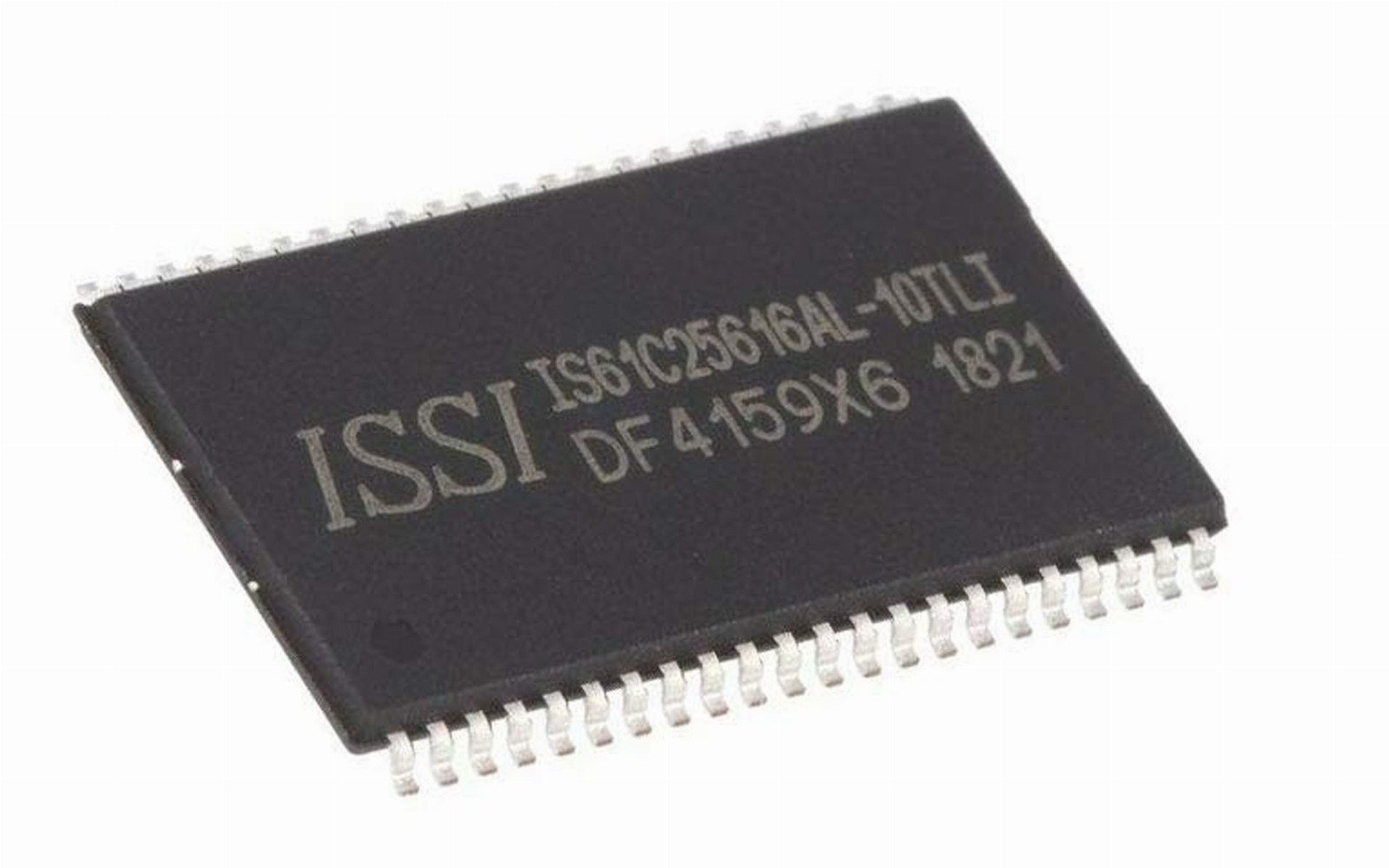
SRAM, or Static Random-Access Memory, is a type of semiconductor memory that uses bistable latching circuitry to store each bit. Unlike DRAM, which must be periodically refreshed to maintain data, SRAM does not need to be refreshed, which makes it faster and more reliable for certain applications. SRAM is called "static" because it can hold its data as long as power is supplied to the system, without the need for constant refreshing.
SRAM is commonly used in small amounts where speed is crucial, such as in the cache memory of processors, in routers, and in other hardware where quick data access is required. Each cell in SRAM typically consists of four to six transistors, making it more expensive per bit compared to DRAM, which uses only one transistor and one capacitor per bit. This complexity allows SRAM to be faster and more reliable but also means it consumes more power and is less dense, making it impractical for high-capacity memory needs.
Pros:
- Speed: SRAM is much faster than DRAM. It provides quicker access to data, making it ideal for cache memory and high-speed registers in CPUs.
- Reliability: Without the need for refresh cycles, SRAM is more reliable for maintaining data integrity in applications where constant data availability is crucial.
- Low Latency: SRAM offers low latency access times, enhancing overall system performance especially in high-performance computing environments.
Cons:
- Cost: Due to its complex structure, SRAM is more expensive to produce than DRAM, making it less cost-effective for large amounts of memory.
- High Power Consumption: SRAM's multiple transistors consume more power than the single transistor and capacitor arrangement in DRAM cells.
- Physical Size: The larger size of SRAM cells, due to using multiple transistors, limits the density of memory that can be packed into a given area, making it unsuitable for use as main system memory.
SRAM's characteristics make it particularly suitable for applications where speed and reliability are more important than capacity and cost, such as in CPU caches where quick data retrieval is critical. While it is not used for large-scale storage due to its high cost and larger size, SRAM remains an essential component in nearly all computing systems, providing fast and reliable access to frequently used data to speed up processor operations.