
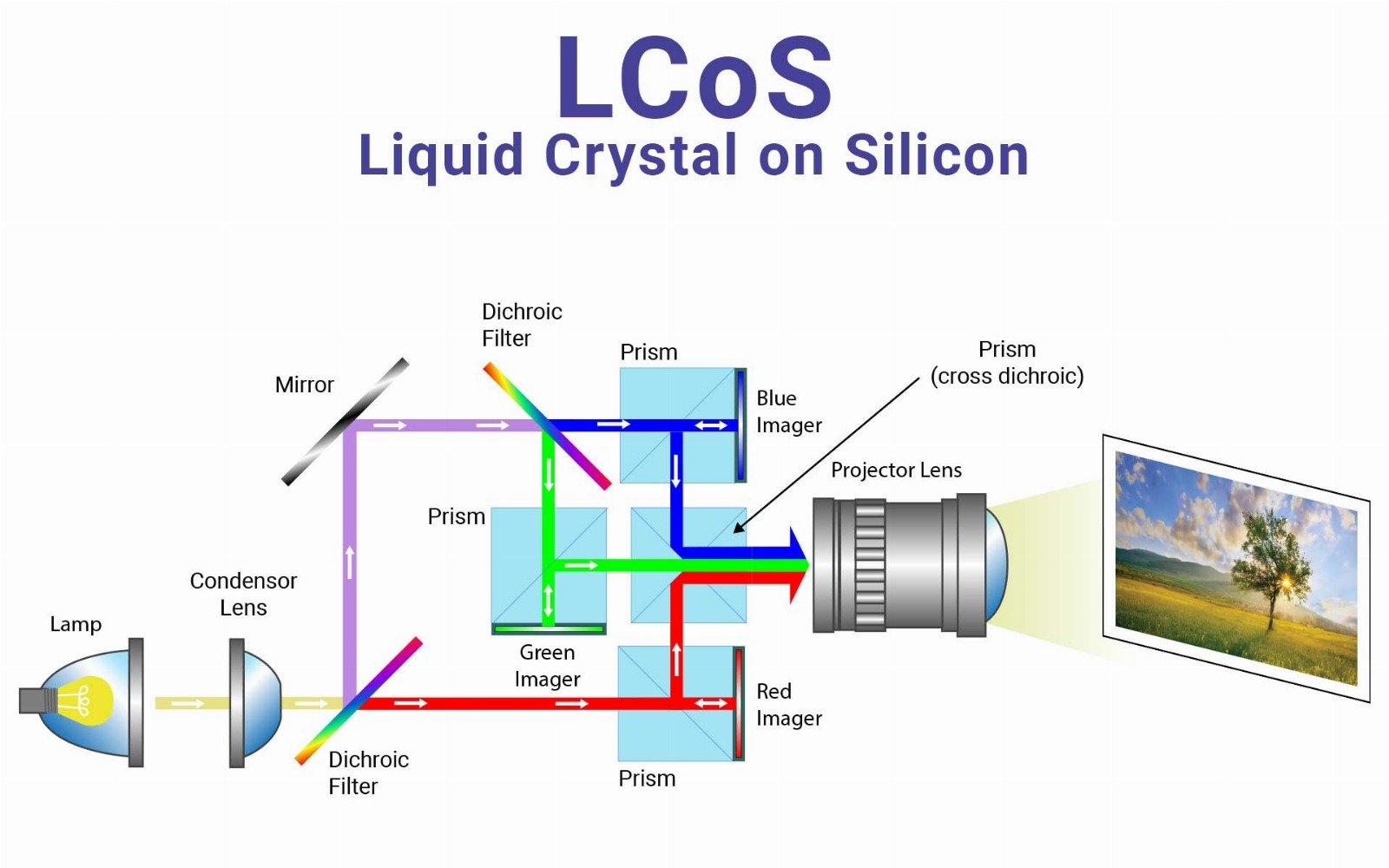
LCoS (Liquid Crystal on Silicon) is an advanced display technology used primarily in projection systems. It is a type of reflective microdisplay technology that combines elements of both LCD (Liquid Crystal Display) and DLP (Digital Light Processing). LCoS uses liquid crystals applied to a reflective mirror substrate, unlike traditional LCDs, which are transmissive. When light shines on the LCoS chip, it is modulated by the liquid crystals before being reflected back through the projector's lens and onto the screen.
How It Works: In LCoS projectors, light from the projector's lamp is split into red, green, and blue components by a prism. Each color of light then passes through an LCoS panel, which is made up of liquid crystals lying on top of a reflective, silicon-based chip. These panels act like tiny mirrors, with the liquid crystals functioning as shutters that can either allow light to reflect off the mirrors or block it. The light that is reflected is then combined again by another prism into the full spectrum of visible light and projected onto the screen.
Pros:
- High Resolution and Image Quality: LCoS technology can produce very high resolutions and smoother images with less visible pixel structure than both DLP and LCD, making it ideal for high-definition displays.
- Excellent Color Reproduction: Provides rich color performance and deep black levels due to the dense layer of liquid crystals and the use of a reflective process.
- No Rainbow Effect: Unlike single-chip DLP projectors that can sometimes produce a rainbow-like artifact, LCoS projectors do not suffer from this issue due to their different light processing method.
Cons:
- Higher Cost: LCoS projectors tend to be more expensive than LCD and DLP projectors due to the complexity of the technology and the manufacturing processes involved.
- Lower Brightness: The reflective nature of LCoS can result in lower light efficiency compared to other projection technologies, which can make LCoS projectors less suitable for environments with high ambient light.
- Complexity in Manufacturing: LCoS technology is complex to manufacture, which can lead to higher prices and less variety in the market compared to other types of projectors.
Conclusion: LCoS technology offers superior resolution and image quality, making it a preferred choice for applications where visual detail and color accuracy are paramount, such as professional presentations, high-end home theaters, and fields requiring detailed visual information like medical imaging. Despite its higher cost and generally lower brightness, the benefits of LCoS in delivering outstanding visual performance make it a valuable option in the high-end projector market.