
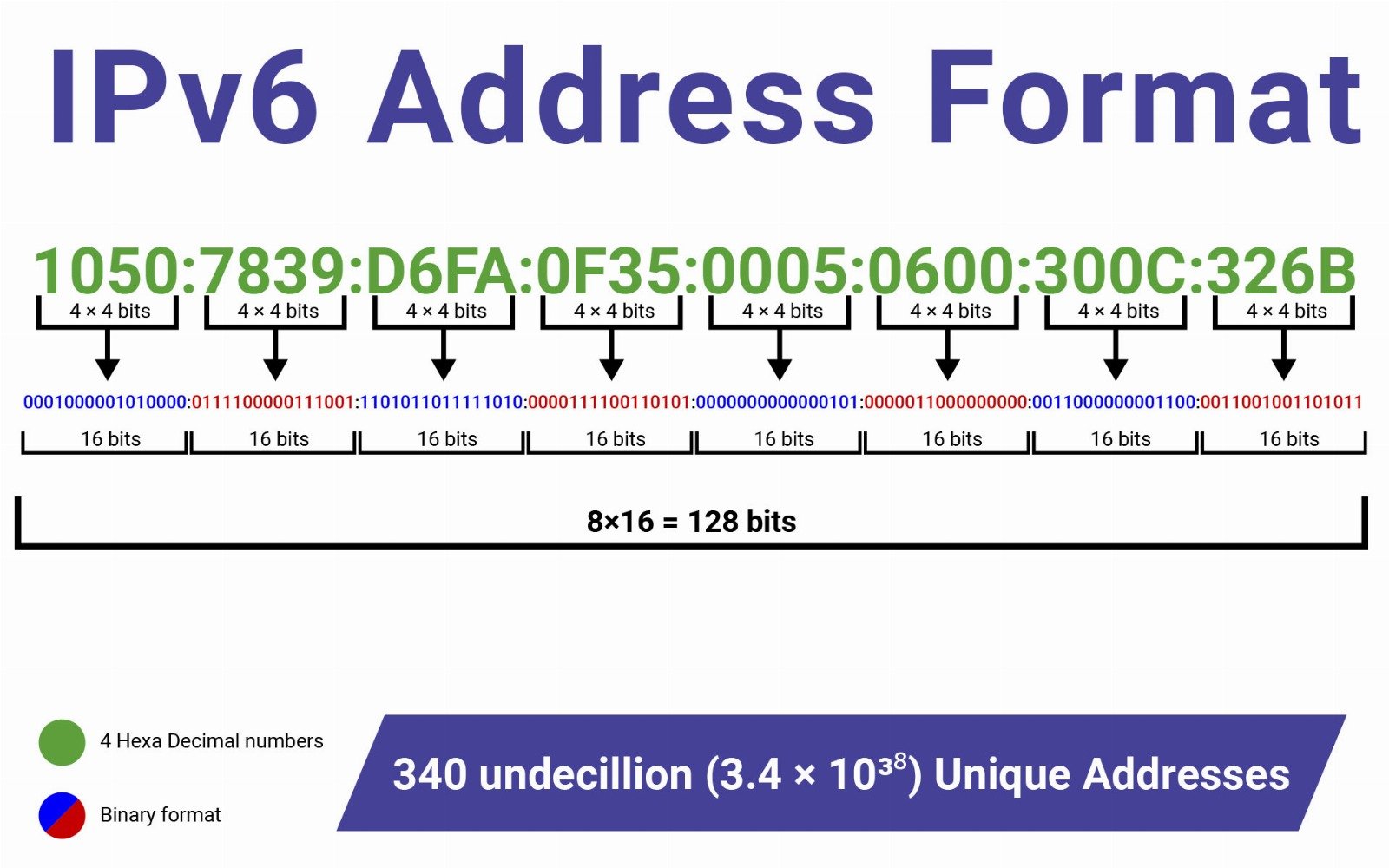
IPv6 is the latest version of the Internet Protocol, designed to replace IPv4 due to its limited address space. Whereas IPv4 uses a 32-bit address system (offering about 4.3 billion addresses), IPv6 uses 128 bits, allowing for an astronomical number of unique IP addresses — 340 undecillion (3.4×10³⁸) to be exact.
IPv6 was developed by the IETF (Internet Engineering Task Force) and officially standardized in 1998, with the purpose of solving IPv4 exhaustion, simplifying routing, improving security, and supporting modern networking requirements.
Structure of an IPv6 Address
IPv6 addresses are written in hexadecimal and separated by colons (:). A typical IPv6 address looks like:
2001:0db8:85a3:0000:0000:8a2e:0370:7334
They can be compressed using shorthand rules:
2001:db8:85a3::8a2e:370:7334
IPv6 supports several address types:
- Unicast: One-to-one communication
- Multicast: One-to-many communication
- Anycast: One-to-nearest (based on routing)
Pros of IPv6
- Vast Address Space: Supports 340 undecillion IP addresses, allowing every device — even every light bulb or sensor — to have a unique IP.
- Simplified Routing: Hierarchical addressing reduces the size and complexity of routing tables.
- Built-in Security: Supports IPsec natively for end-to-end encryption and authentication.
- No Need for NAT: Devices can communicate directly without Network Address Translation, simplifying peer-to-peer connections and improving performance.
- Auto-Configuration: Includes Stateless Address Auto-Configuration (SLAAC), allowing devices to assign themselves IP addresses without a DHCP server.
- Better Multicast and Mobility Support: Improves delivery of streaming content and supports mobile IP more efficiently.
Cons of IPv6
- Incompatibility with IPv4: IPv6 is not backward-compatible with IPv4, requiring dual-stack configurations or translation gateways for interoperability.
- Cost and Complexity of Transition: Upgrading existing infrastructure (routers, firewalls, software) and retraining staff can be expensive and time-consuming.
- Inconsistent Support: Not all ISPs, websites, or applications fully support IPv6 yet, especially in developing regions.
- Misunderstood Security Benefits: While IPv6 supports IPsec, it's not enforced by default, so benefits depend on proper implementation.
IPv4 vs IPv6 Comparison
| Feature | IPv4 | IPv6 |
|---|---|---|
| Address Length | 32 bits | 128 bits |
| Format | Decimal (e.g., 192.168.0.1) | Hexadecimal (e.g., 2001:db8::1) |
| Total Addresses | ~4.3 billion | ~340 undecillion (3.4×10³⁸) |
| Security | Optional (IPsec not native) | Native support for IPsec |
| Configuration | Manual or DHCP | Auto-configuration via SLAAC |
| NAT Required? | Yes (due to address shortage) | No (each device gets a public IP) |
| Backward Compatible? | Yes | No |
Current IPv6 Adoption
As of now, IPv6 adoption is growing steadily, especially in:
- Mobile networks (e.g., Android and iOS devices)
- Large content providers (Google, Facebook, YouTube)
- Countries like India, Germany, and the US
However, IPv4 remains dominant due to legacy systems and slower enterprise adoption.
Conclusion
IPv6 is the future of internet addressing, designed to solve the limitations of IPv4 and enable the massive scaling required by the Internet of Things (IoT), 5G, and global digital infrastructure. While its rollout has been gradual, understanding and preparing for IPv6 is essential for modern networking, especially in enterprise, telecom, and security contexts.
If you’re building or managing networked systems, dual-stack deployment (supporting both IPv4 and IPv6) is the current best practice.